|
Point
six-
Don't pile heavy materials
against
the
wall, and no excessive beating
and
banging
This is largely out of control of the plasterer,
but it
should be insisted
on.
There is nothing worse than seeing a big stack of
sheet rock
stacked
against
the wall, where the the stucco was recently finished on
the other side.
If a sheet rock delivery is made, it can stacked against
a partition
wall, that
doesn't affect the stucco. You can't tell me that a
stack of sheet
rock that
weighs 3000+ lb. leaning against the wall won't bow the
studs enough
to seriously crack the stucco. Since there is no
guarantee against
cracks,
I reserve the right to say nyah nyah nyah, however one
person's action
changes the quality of the product for everyone. So I
must insist and
insist.
The outer walls on the inside are usually the
most
inviting places for
material deliveries, such as paneling, plywood, etc.
Once we had a stucco wall that cracked severely a
few
months after we
finished when a contractor bolted a heavy bay window
assembly to the
wall,
which should have been installed before the stucco.
I took some prospective customers by to show the
house as an
example
of
our work, and to show the great impregnated color. I had
been by a
few
weeks earlier and there wasn't even a small hairline
crack, making
it a great
example( put your best foot forward, right?) I could see
the
disappointment
in their faces when they saw the big nasty cracks
radiating out from
the
bay window.
I was embarrassed.
When they called me to tell me they had decided to
put on a
different
material
on their house, I knew the real reason.
Electrical openings, plumbing rough outs, exhaust
ducts,
etc. should
always
be made before the lath is applied. I have seen
neglected pipe openings
knocked
in later with a sledge hammer. In this event, the holes
should be
carefully
made
with a diamond or carbide blade.
Windows and doors should be checked before the
lath is
applied also,
for alignment, proper opening, etc. Prying a window jamb
or beating
it out will crack the stucco every time.
All I can can do on all these cases is insist
that
these things be observed,
but none are my fault.
On masonry:
Patches and blocks extending walls should always be
toothed in,
and not just butted tight. There will always be a nasty
crack if blocks
aren't
toothed in.
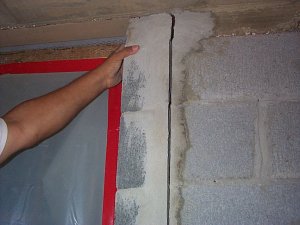
Blocks extended on this multi-million dollar are loose
enough to
shake. I took a picture to show that when a nasty crack
appears, it
was due
to an inadequate substrate.
Last but not least, is to insist that
heavy
roofs, such as slate
or Spanish barrel tile,
be put on before the lath is applied. Several tons of
roofing will
bow the framing
and crack the stucco. The disadvantage of doing this is
that chimneys
and dormers should stuccoed first, to avoid walking on
the roof and
breaking
it up.
When I was in Southern California, I noticed a lot
of times, the
barrel
tiles were loaded on the roof before they were
installed. This allowed
the stucco to proceed
without loading the roof later and cracking the stucco.
|